Banner photograph by Emilie Burnham of the DR Byen neighborhood, a modern urban district along the M1 metro line on the island of Amager, south of central Copenhagen, visited during her time at DAWN.
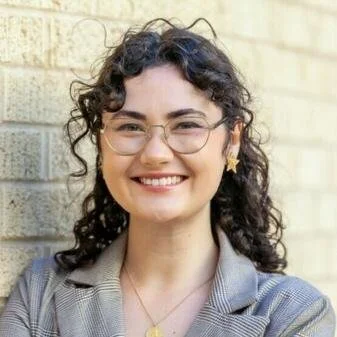
Tell me a little about yourself. I'm finishing my third year as a PhD student at Penn State, where I work with Joel Leja studying galaxy formation and evolution. I have a deep passion for building software and working with data science, and I try to interweave that with the science itself, which tends to focus on star formation in distant galaxies. I did my undergraduate degree at Texas Christian University in Fort Worth, Texas.
My dad was in the military, so I grew up all over the US — born in Arizona, lived in upstate New York near the Canadian border, Hawaii, and various places in Texas, which is where I spent the most time. I don't really identify as being from any one place. I'm just American.
Outside of research, I love to read, particularly books that are too large to fit in a bag, which is why my Kindle has been essential for this trip. I also write my own things, whether more philosophical or fiction. And I love to cook. My approach is to make a new recipe every week and embrace anything complicated; I made an entire Thanksgiving dinner by myself a couple of years ago. My favorite thing to make is risotto.
How did you get interested in astronomy? As a kid, I was obsessed with Nova documentaries. I would watch them secretly, under the covers at night. But I always assumed I wasn't smart enough to actually pursue it. I didn't seriously consider astronomy as a career until college, when I started out in physics and just naturally got funneled toward it. It felt like a complete accident.
What kept me going, and still keeps me going, is that astronomy feels like a pure science. It's curiosity for curiosity's sake, with no obvious practical application driving it, and I find that philosophically very fulfilling. It's also remarkably collaborative compared to many other fields.
What is your favorite part about Copenhagen? DAWN? What I've loved most about Copenhagen is the culture and the people. I've had so many good conversations here, the kind I hadn't had in a long time, with such a wide range of people. The city itself rewards that kind of connection in a way I didn't expect. I also discovered, somewhat by accident, that being in a city is really good for me. I hadn't known that before coming here. It's something I'm now actively thinking about as I look toward future positions.
At DAWN, what strikes me most is how complementary everyone's research is. Here, everyone is interested in the physics of galaxies in the early universe, so research that would be quite niche anywhere else suddenly has a whole room full of people who are genuinely engaged with it. People are focused on their own work but still deeply collaborative and willing to brainstorm, to help, and to forge new connections across projects. That's a rare environment.
What motivated you to apply to an international summer research program? Honestly, I wanted to apply to something competitive for the practice, and if I got in, it would be a great networking opportunity. Since a large part of what I work on is building software, I was particularly motivated by the chance to be around the people who would eventually use that software. Being embedded in that community, hearing what they actually need, was a real draw. I didn't realize until I arrived in Copenhagen how much I thrive in that kind of environment.
Can you tell us about your work this summer? I've been working on two connected projects during my time at DAWN.
The first concerns how we study star formation in early galaxies. In the early universe, star formation in galaxies is thought to be "bursty": galaxies cycle through intense bursts of star formation followed by quiet phases. But when astronomers plan follow-up spectroscopic observations, we naturally tend to target the galaxies that are bright and active (i.e., the ones in a burst). This means the galaxies in a quiet phase get systematically missed. My research concerns understanding how much this selection bias distorts our picture of how bursty these populations really are. Early results suggest that if you don't account carefully for your selection process, you end up thinking that star formation in distant galaxies is much smoother and more uniform than reality, which is consistent with what others in the field have been finding.
The second project is building a new spectral energy distribution (SED) fitting code. SED fitting is a technique for modeling the light emitted by a galaxy across many wavelengths to infer its physical properties, such as how many stars it has, how quickly it's forming new ones, what it's made of. My code uses neural network emulators to do this much faster than conventional approaches, making it possible to fit very large populations of galaxy spectra from next-generation surveys like PFS, MOONS, and DESI. This summer has been focused on developing a robust inference pipeline that produces well-calibrated results. It's still in progress, but it's the kind of tool that the community genuinely needs, and I've had plenty of conversations here at DAWN about exactly how and why.
What skills have you been working on developing this summer? As a Senior Scholar, a big part of my role has been mentoring the undergraduate students, including asking questions about their research, offering outside perspectives, helping them think through problems rather than just giving them answers. That kind of mentorship is a skill in itself, and I've been thinking a lot about pedagogy: what does someone who has never done research before actually need to know, and how do you teach it well?
I've also been working on scientific communication, including how to tailor a talk or a conversation to a specific audience, figuring out what they're curious about, and leaving room for the kinds of questions that can turn into future collaborations.
And as someone who comes from the modeling and simulation side of things, I've been stretching myself to think more like an observer. How does an observer actually plan a survey? What decisions are being made and why? That perspective is hard to develop without being surrounded by people who live it, which is part of why being at DAWN has been so valuable.
What Danish word or phrase have you picked up? I'll be honest, I haven't picked up much Danish. My defaults are hej (hello) and tak (thank you), and that's about it. What I have picked up are Europeanisms. I now say "the bin" instead of "the trash" and "the shop” instead of "the grocery store.”
But the thing I'm genuinely bringing home from Denmark is the breakfast. My favorite is a bun and cheese with a filter coffee! I'm not normally a breakfast person, so this is a big deal.
You can learn more about Emilie’s ongoing research by visiting her professional webpage at https://efburnham.github.io