2026 DAWN Scholar Profile

Meet the DAWN-IRES Scholars: Lucas Zimmermann

Banner photograph by Lucas Zimmermann of the beach at Møns Klint, a coastal area south of Copenhagen, during a weekend trip with fellow scholars.

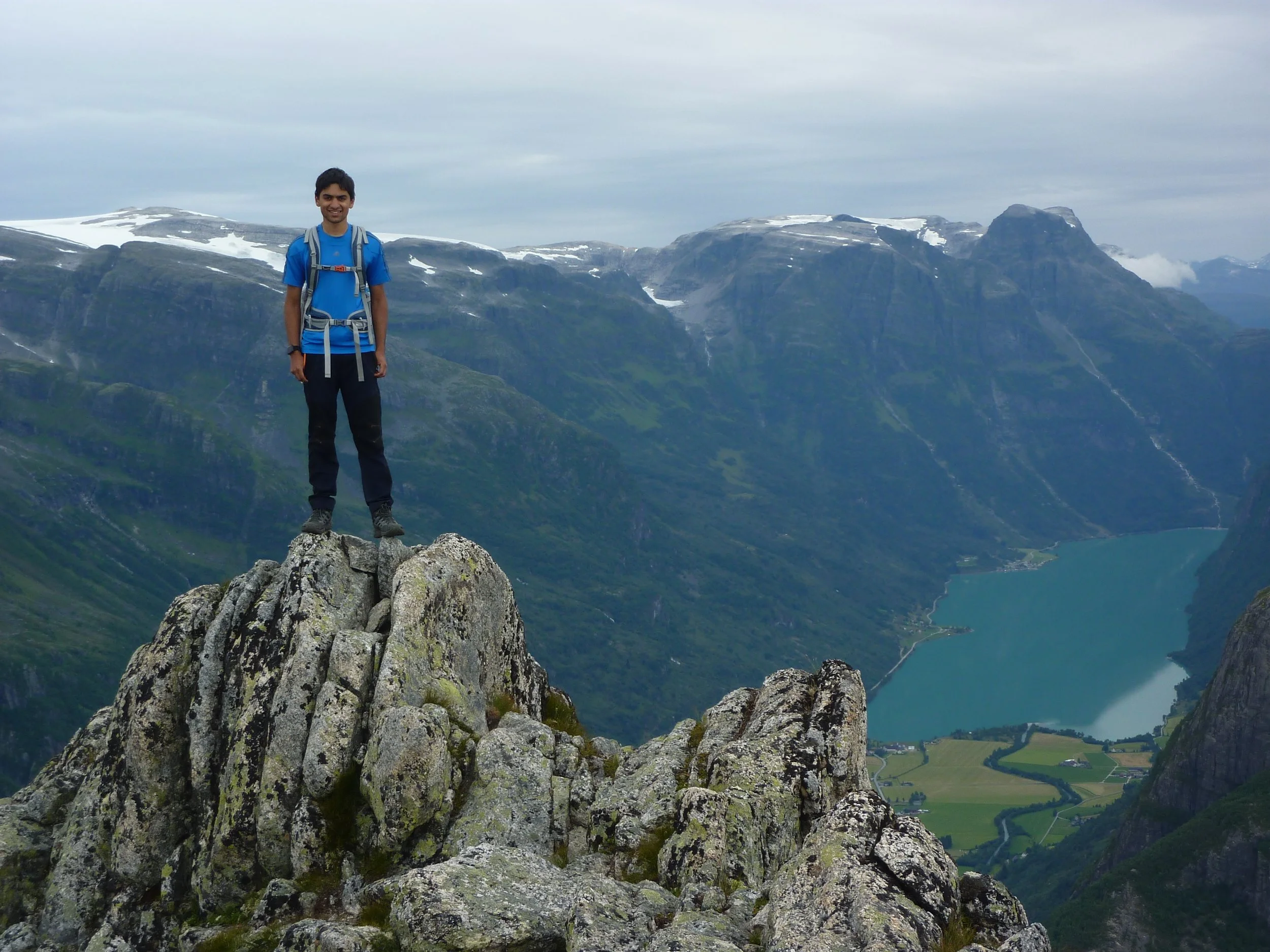
Lucas Zimmermann at the top of Kattanakken in Jostedalsbreen National Park, Norway, during a week-long campervan trip with fellow scholars. Photo by Mahitha Ramachandran.

Tell me a little about yourself. I'm a rising senior at Yale University majoring in astrophysics, and I'm also getting a certificate in data science. This includes courses on statistics, probability and machine learning, which compliment astronomy research very well.

Outside of class, I co-founded the Yale Astronomical and Space Student Society in my sophomore year and have been co-president since. Being able to bring astronomy to those outside the field is very fulfilling. I'm also on Yale's club cycling team, where I race and serve as race coordinator. We compete all over the Northeast, including New York, Connecticut, and Pennsylvania.

How did you get interested in astronomy? I've been interested in astronomy since I was very young — it just stuck. Growing up in Brooklyn, I couldn't see much of the night sky, but I loved learning about it. In middle school I joined the Amateur Astronomers Association of New York, which offered classes I could take to go deeper and help solidify my passion.

My high school, Brooklyn Tech, has an unusual system where you pick a major after two years, which determines your electives. I chose physics, partly because it included an astronomy course that allowed me to learn more.

The summer before my senior year, I spent two months at Yale doing astronomy research through YSPA, the Yale Summer Program in Astrophysics, working with a cohort of about 36 students on near-Earth asteroids. We used telescopes to track how asteroids moved across the sky and modeled their orbits from our observations. That experience was a big reason Yale became my top choice and was my first introduction to doing research. At that point it felt less like a decision and more like the obvious next step.

What is your favorite part about Copenhagen? DAWN? As someone who races bikes, the cycling infrastructure here is genuinely remarkable. I came in with an appreciation for it, and Copenhagen has exceeded every expectation. I rented a commuter bike for getting around, but the local coordinator of the DAWN-IRES program, Peter Laursen, also lent me his road bike for longer rides. I've biked around Amager on the southern end of the city, explored a hillier lake area in the north on a route Peter suggested, and, the highlight, did a century ride with fellow scholar Alexander Poulin, all the way to the northern tip of Zealand, the island Copenhagen sits on.

At DAWN, what stood out most is the cohort. We've traveled together, hung out together, and shared a lot of new experiences. There's also the research culture here, which surprised me — it's much more relaxed than what I'm used to in the US, with people coming in later and leaving earlier. But the amount and quality of research being done is genuinely impressive, and it's a wonderful environment to be part of.

What motivated you to apply to an international summer research program? I love doing research and I love traveling, and this was a chance to combine both. Last summer I spent the time doing research in Santiago, Chile, which was its own incredible experience, and I was excited to try something completely different. I have family in Germany and I've traveled widely in Europe and was happy to have a reason to be here for an extended time. In fact, after the program, I'm heading to Berlin.

Can you tell me about your summer research project? I'm working with Yi Xu and Koki Kakiichi to search for Population III stars, which are the very first stars that ever formed in the universe. These stars are thought to have formed from purely primordial gas containing only hydrogen and helium, with none of the heavier elements that later generations of stars produce. No one has ever directly detected a Population III star, and finding evidence of them is one of the outstanding goals of modern astronomy.

My approach is to search in the outskirts of massive galaxies when the early universe was roughly 700 million to one billion years old. The idea is that small pockets of gas near these massive galaxies may stay metal-free for longer, kept pristine by radiation from the galaxy next door, making them more likely to host Population III star formation.

I'm working with existing IFU data, which are observations taken with instruments that capture a spectrum at every point in the field of view, not just a single spectrum or a single image. The surveys were originally designed to study the massive galaxies themselves, but I'm searching their outskirts for candidates. The signature I'm looking for is a detection of hydrogen emission with no metal lines. That absence is the tell, as it suggests the gas is still primordial. I can't say definitively that any individual object is a Population III star, but I can use my detection limits and candidate counts to constrain theoretical predictions for how many such stars should exist in the volume of sky I've searched.

What skills or knowledge have you been working on developing so far this summer? Working with spectra has been the main new skill. I hadn't done much of it in a real research context before, such as measuring the brightness of an emission line, subtracting the background, and fitting a mathematical curve to an emission feature to measure its strength precisely. And then, practically, how you pull individual spectra out of a three-dimensional IFU data cube. These are skills that can take a while to build, but having a project that required all of them has pushed me to develop them relatively fast.

What Danish word or phrase have you picked up that you now use constantly? Skink — the word for ham, which is the same in Danish and Norwegian. I learned it on a campervan trip to Norway with fellow scholars Alex and Mahitha. We rented a van in Sweden, drove up through Norway, hiked mountains, and ate a lot of sandwiches. Ham was a staple, so every time we went to a grocery store we were on the hunt for skink. We thought it sounded funny, and it became a running joke for the whole trip.

Meet the DAWN-IRES Scholars: Alexander Poulin

Banner photograph of the beach at Tisvilde, a small coastal town on the northern tip of Zealand, taken at roughly mile 60 of Alexander’s 100-mile bike ride.

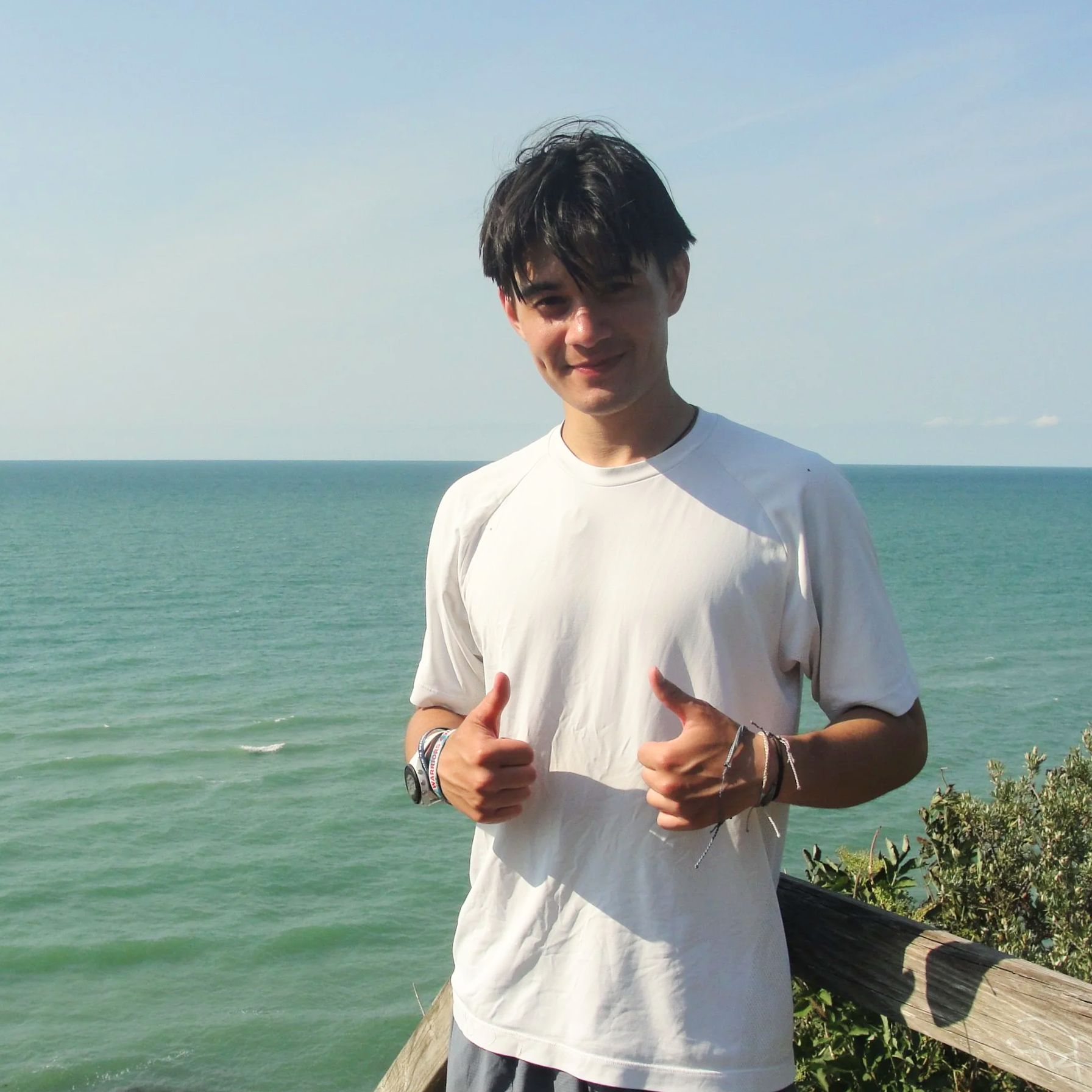
Picture of Alexander Poulin at the beach of Tisvilde, one of the destinations along his 100 mile bike ride, taken by fellow scholar Lucas Zimmerman.

Tell me a little about yourself. I’m a rising senior at Northeastern University in Boston, majoring in computer science and physics with a minor in astrophysics. At Northeastern, I’ve had the chance to explore a lot of different areas of physics research, including particle physics at CERN, condensed matter, and more recently astrophysics. I grew up in Sudbury, Massachusetts, so I’m not too far from home.

Outside of research, I enjoy cooking and baking, my favorite things to make are cinnamon rolls and croissants. I take film photographs and develop and scan them myself. I’ve played ice hockey pretty much my whole life, starting when I was about four. I also played baseball and soccer growing up, but hockey was always my number one passion. I’ve tried to keep it going in college through intramurals, though Northeastern’s rink was recently torn down, so we’ve been without one this past year.

How did you get interested in astronomy? Growing up, I watched a lot of VSauce, a YouTube channel that makes STEM content entertaining. They covered a wide range of stem topics including astronomy, which got me thinking about it. But things clicked more concretely in high school, when I did research at STAR Laboratories (Speech Technology and Applied Research) in Lexington, Massachusetts. My mentor there had studied astrophysics and sometimes our conversations would evolve into astronomy topics. Many of the signal processing techniques used in speech research carry over directly to astronomy, and that connection made me see how I could combine my interest in computer science with physics, and eventually land in astrophysics.

What is your favorite part about Copenhagen? DAWN? The biking culture has been incredible. Before coming here, I genuinely hadn’t ridden a bike since I was about 12, so I was pretty rusty at first. Now I bike everywhere, to NBI and even all the way out to DTU, which is 12 miles one way. One of my favorite moments during the program so far has been biking over 100 miles in a single day with a fellow scholar and friend, Lucas Zimmermann, all the way to the northern tip of Zealand (the island the majority of Copenhagen sits on) to Gilleleje and Tisvilde.

At DAWN, what stands out is having a large group of people all working on astronomy. At Northeastern, there are only a handful of astronomy faculty, and research tends to happen in fairly isolated lab settings. DAWN feels much more collaborative; people are genuinely willing to help each other, and there isn’t the kind of hierarchy you might expect to find.

What motivated you to apply to an international summer research program? I hadn’t traveled much before this. I’d only been outside the East Coast once. This felt like a real opportunity to actually immerse myself in another culture for an extended period rather than just visiting. I also have graduate school applications coming up and wanted to get a sense of what the culture in Europe is like, and what science and doing research in Europe might be like.

Can you tell me about your summer research project? I’m working with Shuowen Jin and Marko Shuntov on a search for unusual objects in COSMOS-Web, a wide-area survey conducted by the James Webb Space Telescope (JWST).

Specifically, I’m looking for objects that are invisible at shorter near-infrared wavelengths but suddenly appear bright at longer ones, which we call “F277W dropouts”. Exactly what these dropout objects are, their properties, and their origins, is still unclear. They could be distant star-forming galaxies, stars in our own Milky Way, distant massive black holes, or the mysterious compact objects known as “Little Red Dots” that JWST has been uncovering.

We found 29 such dropout objects in total. Without spectral data, which measures light intensity by wavelength, we’ve had to rely entirely on JWST photometry and radio data from ALMA, MeerKAT, and the VLA to characterize the objects by modeling their light across multiple wavelengths, a technique called spectral energy distribution (SED) fitting. Some of the objects were large dusty galaxies resulting in relatively straightforward SED fitting, while others were far more compact, requiring that we stacked their images together to analyze their combined light. Even still it’s hard to say definitively what they are, and that’s still what we’re working toward.

What skills or knowledge have you been working on developing so far this summer? My previous research has been mostly simulation-based, so observational work has been the big new frontier, including learning to work with telescope images, run statistical analyses on real data, and account for how the specifics of each instrument affect what we actually measure. SED fitting was entirely new to me as well.

More broadly, I’ve been developing independence as a researcher. This project is genuinely open-ended: my mentors and I are both trying to figure out the same problem. That back-and-forth, where nobody already knows the answer, is what research actually feels like, and learning to navigate that has been one of the most valuable parts of the summer.

What Danish word or phrase have you picked up that you now use constantly? Tillykke med fødselsdagen — happy birthday. In June, I convinced a few of the other scholars to join me at Peter Laursen’s boxing class. We found out ahead of time that it was his birthday, and we tracked down his personal website, which has a recipes page. One of the recipes was his own rhubarb white chocolate cake. We decided to bake it for him, which, while it did not go well, hopefully showed our appreciation for the help and work he has done for us. We scrapped the whole thing and got him baked goods instead. But after the boxing class, we wished him a happy birthday in Danish, which he seemed genuinely touched by.

Meet the DAWN-IRES Scholars: Maya Berhane

Banner photograph by Maya Berhane of the waterfront view from the Louisiana Museum of Modern Art in Humlebæk, Denmark.

Maya Berhane at the Museo Galileo in Florence, Italy, in front of an armillary sphere — a historic instrument once used to model the motions of celestial bodies. Maya visited during her vacation week mid-program.

Tell me a little about yourself.  I'm a rising senior at the University of Washington, where I double major in physics and astronomy, with a minor in American ethnic studies. The minor started organically — I was taking those classes because they interested me, and at some point figured I might as well formalize it. I once had bigger plans, including a second minor in applied mathematics, but I had to be realistic.

I was born and raised in the Pacific Northwest, in Washington State. My parents are both immigrants from Eritrea, a small country in East Africa near the Horn of Africa, bordering Ethiopia. My dad came to the US when he was 16; my mom first emigrated to Britain and then came here, where she was introduced to my dad through my aunt. Outside of research, I've read every day since I was about 10 — I find real comfort in it, especially now that I'm staring at a screen all day. I also journal, draw, and did karate for over a decade.

How did you get interested in astronomy?  When I was a kid, I spent a lot of time staring out the window wondering what was up there. I'd ask my dad questions — he's an electrical engineer — and we'd sit down and watch YouTube videos together about whatever I was curious about. I remember watching a video about string theory around age 10 and having absolutely no idea what I was seeing. But that was it. I've known I wanted to do astrophysics since then.

When I got to college, I quickly discovered that modern astronomy means a lot of coding. My childhood fantasy had involved peering through a telescope; the reality is more like writing scripts and staring at data. But I've come around. Coding is a tool that helps you better understand the universe — and there are scientific plots out there that are genuinely beautiful.

What is your favorite part about Copenhagen? DAWN? The biking infrastructure is remarkable, genuinely better than anything I've experienced in the US. Seattle, where I'm from, is so hilly that biking isn't really practical most of the time, so being somewhere flat with dedicated bike lanes everywhere has been a revelation. Danes also take their traffic rules seriously. I jaywalked on my first day and got some very pointed looks. I've since seen a local on a bike yell at tourists for riding slowly on the left side of the path — the left is for passing only.

At DAWN, what I love most is that it's a hub for extragalactic astronomy — the study of galaxies beyond our own Milky Way — which is exactly what I want to pursue for my PhD. Everyone here is working on something I find genuinely interesting, and there are talks every week. It's an environment where I can always find someone to learn from.

What motivated you to apply to an international summer research program? At UW, I'm a resident advisor, which comes with a contract that makes studying abroad really complicated to arrange. This summer was essentially my window. I'd also never been to Europe before, and I was curious about what it would be like to work with scientists from outside the US and experience research in a different setting. I'm really glad I came — I've even thought about working at DAWN someday.

Can you tell me about your summer research project? I'm working with Ugnė Dudzevičiūtė and Pablo Araya-Araya at DAWN/DTU on dusty star-forming galaxies — galaxies that are forming stars at an extraordinary rate, but whose visible light is heavily obscured by dust, making them difficult to detect in ordinary optical images. We're approaching the problem from two sides: what we observe, and what theoretical models predict.

On the observational side, I'm working with galaxies from the AS2UDS survey, which used ALMA (the Atacama Large Millimeter/submillimeter Array) to detect these galaxies through their dust emission at millimeter wavelengths. On the theoretical side, I'm drawing on two galaxy formation simulations: L-Galaxies, which uses simplified rules to track how galaxies grow and evolve, and Illustris, which models the physics of gas, stars, and dark matter in full detail.

My task is to find counterparts for each observed galaxy within the simulations — matching them by brightness and distance — and then compare their physical properties: how much dust they contain, how fast they are forming stars, and how those properties evolved over time. The dust modeling in simulations is tricky; dust tends to be added after the fact rather than tracked from the start, which created some complications. But I've worked through the matching phase and am now building star formation histories to see what the simulations can and can't reproduce.

What skills or knowledge have you been working on developing so far this summer? Cleaner, more intentional coding. I can code — but I've had a habit of hard-coding values directly into my scripts rather than writing flexible, reusable functions. That bit me a few times; there was a three-day bug that turned out to be nothing more than me overwriting my own variable. I'm trying to be more organized and deliberate about how I write code so it's easier to read, reuse, and debug later.

What Danish word or phrase have you picked up that you now use constantly?  Tak — thank you. I feel guilty walking up to Danish people and immediately launching into English, so saying at least one word in their language makes me feel a little better. I'm also on a Duolingo family plan with another scholar in the program, which has been fun, though the app hasn't exactly made me fluent. My goal before the summer ends is to say something other than tak to an actual person — Danish pronunciation is intimidating enough that I'm not making any promises.