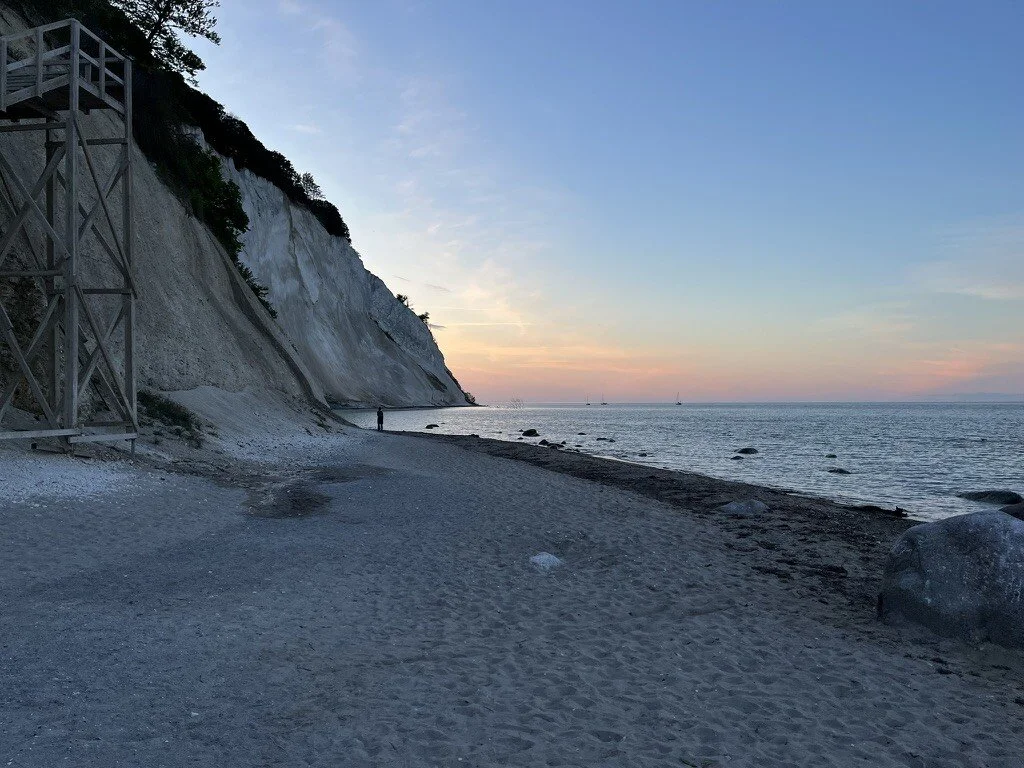
Banner photograph by Lucas Zimmermann of the beach at Møns Klint, a coastal area south of Copenhagen, during a weekend trip with fellow scholars.
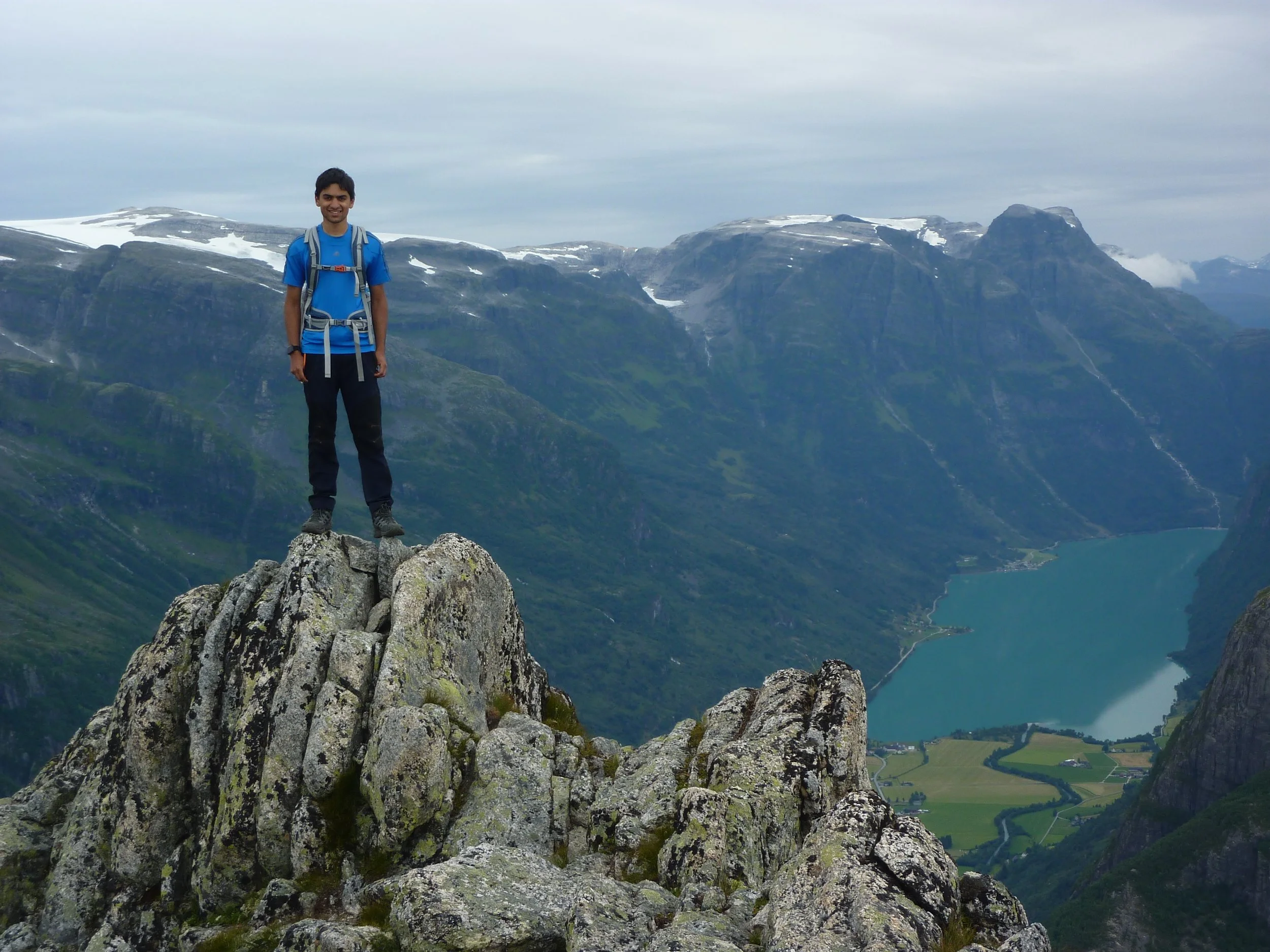
Lucas Zimmermann at the top of Kattanakken in Jostedalsbreen National Park, Norway, during a week-long campervan trip with fellow scholars. Photo by Mahitha Ramachandran.
Tell me a little about yourself. I'm a rising senior at Yale University majoring in astrophysics, and I'm also getting a certificate in data science. This includes courses on statistics, probability and machine learning, which compliment astronomy research very well.
Outside of class, I co-founded the Yale Astronomical and Space Student Society in my sophomore year and have been co-president since. Being able to bring astronomy to those outside the field is very fulfilling. I'm also on Yale's club cycling team, where I race and serve as race coordinator. We compete all over the Northeast, including New York, Connecticut, and Pennsylvania.
How did you get interested in astronomy? I've been interested in astronomy since I was very young — it just stuck. Growing up in Brooklyn, I couldn't see much of the night sky, but I loved learning about it. In middle school I joined the Amateur Astronomers Association of New York, which offered classes I could take to go deeper and help solidify my passion.
My high school, Brooklyn Tech, has an unusual system where you pick a major after two years, which determines your electives. I chose physics, partly because it included an astronomy course that allowed me to learn more.
The summer before my senior year, I spent two months at Yale doing astronomy research through YSPA, the Yale Summer Program in Astrophysics, working with a cohort of about 36 students on near-Earth asteroids. We used telescopes to track how asteroids moved across the sky and modeled their orbits from our observations. That experience was a big reason Yale became my top choice and was my first introduction to doing research. At that point it felt less like a decision and more like the obvious next step.
What is your favorite part about Copenhagen? DAWN? As someone who races bikes, the cycling infrastructure here is genuinely remarkable. I came in with an appreciation for it, and Copenhagen has exceeded every expectation. I rented a commuter bike for getting around, but the local coordinator of the DAWN-IRES program, Peter Laursen, also lent me his road bike for longer rides. I've biked around Amager on the southern end of the city, explored a hillier lake area in the north on a route Peter suggested, and, the highlight, did a century ride with fellow scholar Alexander Poulin, all the way to the northern tip of Zealand, the island Copenhagen sits on.
At DAWN, what stood out most is the cohort. We've traveled together, hung out together, and shared a lot of new experiences. There's also the research culture here, which surprised me — it's much more relaxed than what I'm used to in the US, with people coming in later and leaving earlier. But the amount and quality of research being done is genuinely impressive, and it's a wonderful environment to be part of.
What motivated you to apply to an international summer research program? I love doing research and I love traveling, and this was a chance to combine both. Last summer I spent the time doing research in Santiago, Chile, which was its own incredible experience, and I was excited to try something completely different. I have family in Germany and I've traveled widely in Europe and was happy to have a reason to be here for an extended time. In fact, after the program, I'm heading to Berlin.
Can you tell me about your summer research project? I'm working with Yi Xu and Koki Kakiichi to search for Population III stars, which are the very first stars that ever formed in the universe. These stars are thought to have formed from purely primordial gas containing only hydrogen and helium, with none of the heavier elements that later generations of stars produce. No one has ever directly detected a Population III star, and finding evidence of them is one of the outstanding goals of modern astronomy.
My approach is to search in the outskirts of massive galaxies when the early universe was roughly 700 million to one billion years old. The idea is that small pockets of gas near these massive galaxies may stay metal-free for longer, kept pristine by radiation from the galaxy next door, making them more likely to host Population III star formation.
I'm working with existing IFU data, which are observations taken with instruments that capture a spectrum at every point in the field of view, not just a single spectrum or a single image. The surveys were originally designed to study the massive galaxies themselves, but I'm searching their outskirts for candidates. The signature I'm looking for is a detection of hydrogen emission with no metal lines. That absence is the tell, as it suggests the gas is still primordial. I can't say definitively that any individual object is a Population III star, but I can use my detection limits and candidate counts to constrain theoretical predictions for how many such stars should exist in the volume of sky I've searched.
What skills or knowledge have you been working on developing so far this summer? Working with spectra has been the main new skill. I hadn't done much of it in a real research context before, such as measuring the brightness of an emission line, subtracting the background, and fitting a mathematical curve to an emission feature to measure its strength precisely. And then, practically, how you pull individual spectra out of a three-dimensional IFU data cube. These are skills that can take a while to build, but having a project that required all of them has pushed me to develop them relatively fast.
What Danish word or phrase have you picked up that you now use constantly? Skink — the word for ham, which is the same in Danish and Norwegian. I learned it on a campervan trip to Norway with fellow scholars Alex and Mahitha. We rented a van in Sweden, drove up through Norway, hiked mountains, and ate a lot of sandwiches. Ham was a staple, so every time we went to a grocery store we were on the hunt for skink. We thought it sounded funny, and it became a running joke for the whole trip.