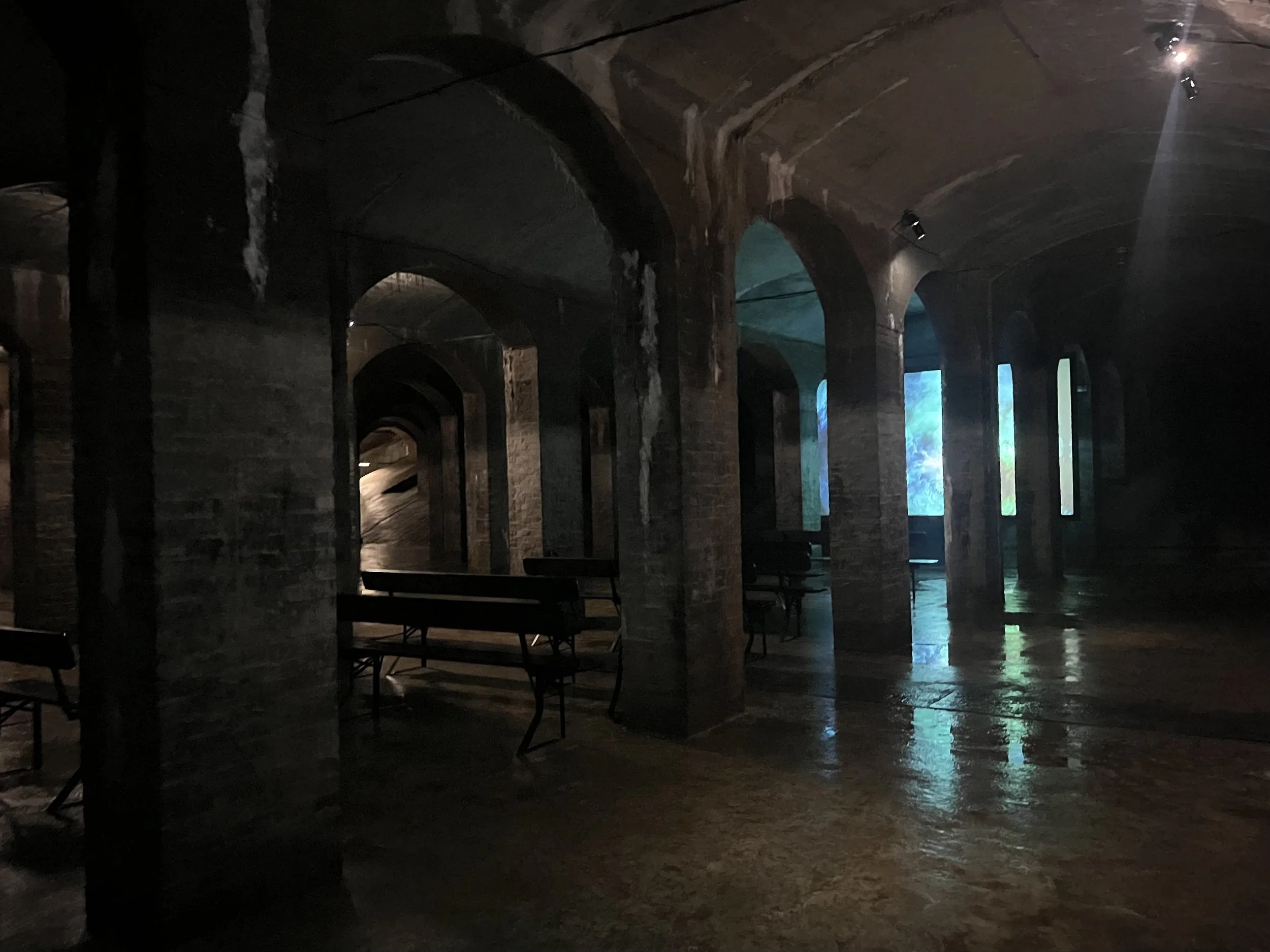
Banner photograph by Mahitha Ramachandran of the Cisternerne, a former water reservoir turned underground art space in Frederiksberg, Copenhagen.
Meet the DAWN-IRES Scholars: Mahitha Ramachandran
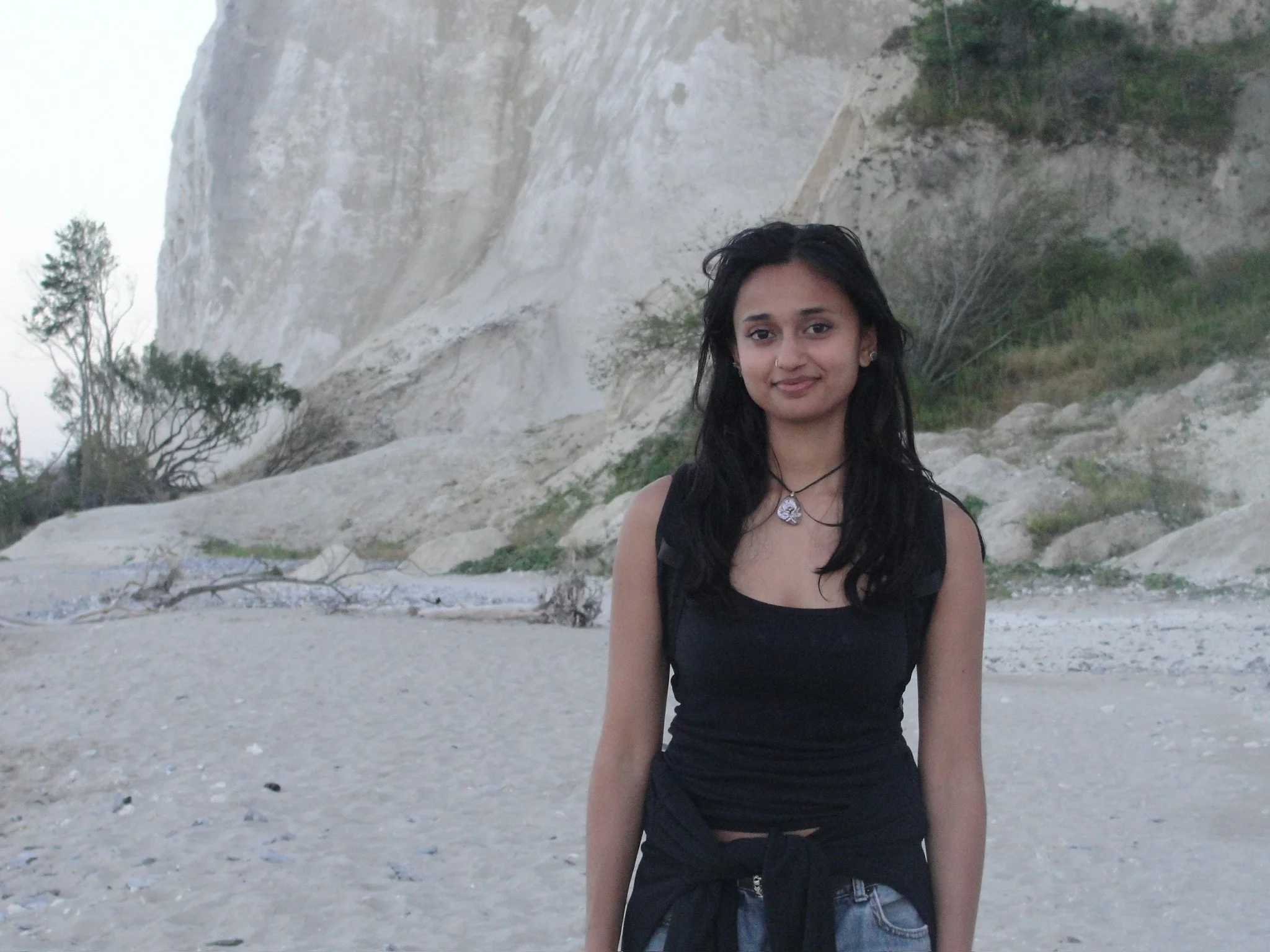
Mahitha standing in front of the white cliffs at Møns Klint. Photo taken by cohort member Alexander Poulin.
Tell me a little about yourself. I'm an undergraduate at Yale University going into my senior year, majoring in Astrophysics and South Asian Studies — two very different things, but I think they represent the breadth of my interests well. I did my first year at the University of Pittsburgh before transferring to Yale.
Outside of astronomy I am particularly interested in art and art history, especially in relation to South Asia. I make my own art as well. I weave on a floor loom, make ceramics and jewelry, embroider, and sew, and I'm constantly exploring new mediums. I also play piano and have done some music production. This past year, I turned astronomical images from the James Webb Space Telescope into music using sonification techniques as part of a multimedia installation project.
How did you get interested in astronomy? I was always curious about space growing up. I think it comes naturally to children to look up and wonder. In high school, I had a really amazing physics teacher who made me love it and, just as importantly, made me believe I could do it. Around the same time, I started volunteering at the Carnegie Science Center's Buhl Planetarium in Pittsburgh, where I got to teach people of all different ages and knowledge levels about astronomy. Teaching it in that kind of environment made me love it more. I think there's something inspiring about the natural fascination and awe that astronomy strikes in everyone.
I see astronomy, the scientific pursuit, as just one way to understand the universe and our place in it — to connect to the people who came before us and those who will come after, and to make sense of the simultaneous vastness and minuteness of our existence. Those big questions have always really consumed me. When I was around 16 to 18 years old and being asked to figure out what I wanted to do with my life, astronomy felt like a way to swim rather than drown in those questions.
I love that astronomy tugs you in every direction; we think about timescales on the order of billions of years right beside events you'll miss if you blink. I'm also fascinated that we look into the past and try to decipher it, or even use it to predict the future. In that sense, I think astronomers are historians and archaeologists, which resonates with my other interests.
What is your favorite part about Copenhagen? DAWN? It is genuinely hard to pick a favorite thing about Copenhagen. I love the transportation infrastructure. I’m a huge public transit advocate, and I use it every day here. I also love the many green spaces integrated into the city.
But I think my favorite thing is the arts scene, and the genuine appreciation and respect for art that seems to be woven into the culture of the city. I've been to countless museums, galleries, exhibitions, and performances and still have a never-ending list of more to go to. But it's more than just the major institutions — the city itself is filled with art and design, whether in the fashion, the street art, or the architecture. It feels like life here is understood to be entangled with art, and there's a real investment in that entanglement.
At DAWN, my favorite thing is the sense of community and collaboration. The rigid hierarchy that you find in a lot of academic spaces doesn't seem to really exist here. People want to discuss, share, and spend time together, and they genuinely value each other. I think that's a really ideal environment for anyone, but especially for an undergraduate student.
What motivated you to apply to an international summer research program? Growing up, my family moved a lot. I graduated high school in Pittsburgh but lived in four other states before Pennsylvania. Moving that frequently was hard in the moment, but in hindsight it shaped me in a lot of good ways. I developed a strong sense of self, because every time you start over you have to look inward and figure out what you actually want, what kinds of friends, what kinds of activities. The fear of going somewhere new disappeared, which made me adventurous.
I think that's a big reason I felt comfortable transferring universities, and a big reason I was drawn to an international program. I had never lived outside the United States for a significant amount of time, so that was naturally an exciting prospect. I love to explore and meet new kinds of people, and I think experiences like this expand my understanding of both the world and myself.
Can you tell me about your summer research project? I'm working with Joris Witstok and Alex Cameron on exploring a new data release from JADES, a deep survey conducted by JWST that has collected imaging and spectroscopy of galaxies in the early universe — from when the universe was roughly half a billion to about 2 billion years old.
Specifically, I'm investigating how we can use emission line diagnostics to better understand the conditions inside those early galaxies. When galaxies form stars, the radiation from those stars excites the surrounding gas, causing it to emit light at specific wavelengths, which we can see in a spectrum. The ratios between different emission lines can tell us about galaxy properties like their stellar mass, at what rate they are forming stars, and the chemical composition of their gas.
These kinds of diagnostics have been well studied in nearby galaxies, but we've previously been limited to relatively small samples of distant galaxies from the early universe. Now, with this new JADES data release, we have high-quality spectra for over a thousand early galaxies at once, which opens the door to mapping out broader trends and comparing what we observe to predictions from theoretical models. I'm working with both well-known strong emission lines and some less-studied diagnostics. The goal is to build a better empirical picture of how these line ratios relate to other galaxy properties at cosmic dawn.
What skills or knowledge have you been working on developing so far this summer? I've done research in previous summers, but I'd never worked with high-redshift galaxies before, so a lot of the early work was building up knowledge about the early universe and the new considerations that come with it.
More broadly, I'm working on developing scientific independence — learning to take the research in directions I'm interested in, rather than just completing a set of steps laid out by my advisors. I'm lucky that my mentors have been really encouraging of that, allowing me to explore beyond their suggestions. I won't pretend I'm there yet; it takes a lot of trust in yourself, and that's genuinely hard. But I think it's something I'll gradually get more comfortable with, and it feels like an important part of growing as a scientist.
What Danish word or phrase have you picked up that you now use constantly? Before the summer started, I went on an Internet hunt for things happening in Denmark during the summer, and I found out about Roskilde Festival — a huge, completely nonprofit, volunteer-run music festival about 30 minutes by train from Copenhagen. If you volunteer at the festival, you get in for free, so I emailed every volunteer group I could find and finally landed a spot selling festival train tickets at Roskilde Station.
The festival was a couple weeks ago, and during my volunteer shifts I picked up the numbers in Danish very quickly as people told me how many tickets they wanted: en billet, to billetter, tre billetter — one ticket, two tickets, three tickets. I also made some great Danish friends at the festival who taught me skål (cheers), though they told me I pronounce it in a very Swedish way. It was an exhausting week as I was going after work and camping there on weekends, but it was completely worth it.