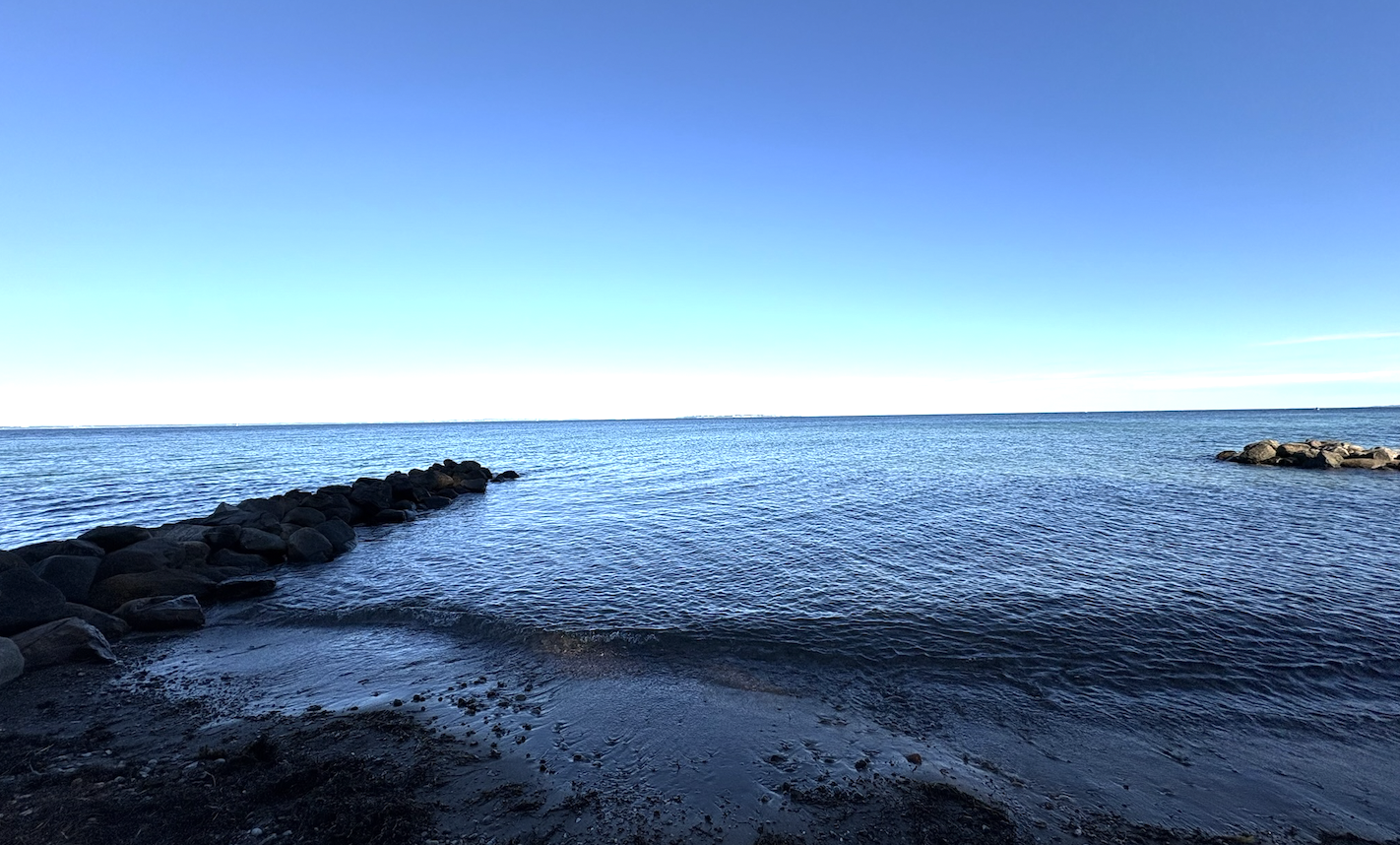
Banner photograph by Maya Berhane of the waterfront view from the Louisiana Museum of Modern Art in Humlebæk, Denmark.
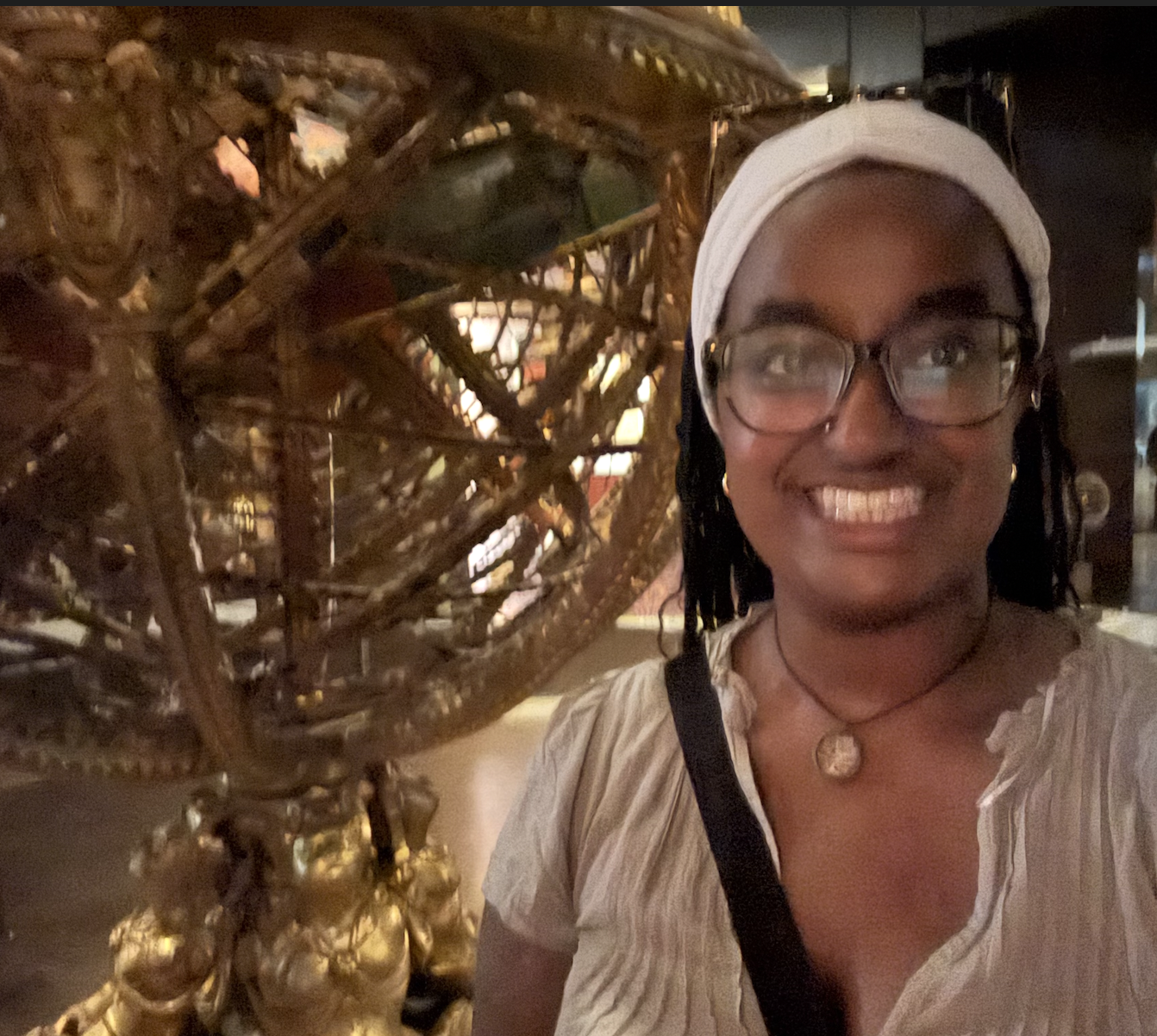
Maya Berhane at the Museo Galileo in Florence, Italy, in front of an armillary sphere — a historic instrument once used to model the motions of celestial bodies. Maya visited during her vacation week mid-program.
Tell me a little about yourself. I'm a rising senior at the University of Washington, where I double major in physics and astronomy, with a minor in American ethnic studies. The minor started organically — I was taking those classes because they interested me, and at some point figured I might as well formalize it. I once had bigger plans, including a second minor in applied mathematics, but I had to be realistic.
I was born and raised in the Pacific Northwest, in Washington State. My parents are both immigrants from Eritrea, a small country in East Africa near the Horn of Africa, bordering Ethiopia. My dad came to the US when he was 16; my mom first emigrated to Britain and then came here, where she was introduced to my dad through my aunt. Outside of research, I've read every day since I was about 10 — I find real comfort in it, especially now that I'm staring at a screen all day. I also journal, draw, and did karate for over a decade.
How did you get interested in astronomy? When I was a kid, I spent a lot of time staring out the window wondering what was up there. I'd ask my dad questions — he's an electrical engineer — and we'd sit down and watch YouTube videos together about whatever I was curious about. I remember watching a video about string theory around age 10 and having absolutely no idea what I was seeing. But that was it. I've known I wanted to do astrophysics since then.
When I got to college, I quickly discovered that modern astronomy means a lot of coding. My childhood fantasy had involved peering through a telescope; the reality is more like writing scripts and staring at data. But I've come around. Coding is a tool that helps you better understand the universe — and there are scientific plots out there that are genuinely beautiful.
What is your favorite part about Copenhagen? DAWN? The biking infrastructure is remarkable, genuinely better than anything I've experienced in the US. Seattle, where I'm from, is so hilly that biking isn't really practical most of the time, so being somewhere flat with dedicated bike lanes everywhere has been a revelation. Danes also take their traffic rules seriously. I jaywalked on my first day and got some very pointed looks. I've since seen a local on a bike yell at tourists for riding slowly on the left side of the path — the left is for passing only.
At DAWN, what I love most is that it's a hub for extragalactic astronomy — the study of galaxies beyond our own Milky Way — which is exactly what I want to pursue for my PhD. Everyone here is working on something I find genuinely interesting, and there are talks every week. It's an environment where I can always find someone to learn from.
What motivated you to apply to an international summer research program? At UW, I'm a resident advisor, which comes with a contract that makes studying abroad really complicated to arrange. This summer was essentially my window. I'd also never been to Europe before, and I was curious about what it would be like to work with scientists from outside the US and experience research in a different setting. I'm really glad I came — I've even thought about working at DAWN someday.
Can you tell me about your summer research project? I'm working with Ugnė Dudzevičiūtė and Pablo Araya-Araya at DAWN/DTU on dusty star-forming galaxies — galaxies that are forming stars at an extraordinary rate, but whose visible light is heavily obscured by dust, making them difficult to detect in ordinary optical images. We're approaching the problem from two sides: what we observe, and what theoretical models predict.
On the observational side, I'm working with galaxies from the AS2UDS survey, which used ALMA (the Atacama Large Millimeter/submillimeter Array) to detect these galaxies through their dust emission at millimeter wavelengths. On the theoretical side, I'm drawing on two galaxy formation simulations: L-Galaxies, which uses simplified rules to track how galaxies grow and evolve, and Illustris, which models the physics of gas, stars, and dark matter in full detail.
My task is to find counterparts for each observed galaxy within the simulations — matching them by brightness and distance — and then compare their physical properties: how much dust they contain, how fast they are forming stars, and how those properties evolved over time. The dust modeling in simulations is tricky; dust tends to be added after the fact rather than tracked from the start, which created some complications. But I've worked through the matching phase and am now building star formation histories to see what the simulations can and can't reproduce.
What skills or knowledge have you been working on developing so far this summer? Cleaner, more intentional coding. I can code — but I've had a habit of hard-coding values directly into my scripts rather than writing flexible, reusable functions. That bit me a few times; there was a three-day bug that turned out to be nothing more than me overwriting my own variable. I'm trying to be more organized and deliberate about how I write code so it's easier to read, reuse, and debug later.
What Danish word or phrase have you picked up that you now use constantly? Tak — thank you. I feel guilty walking up to Danish people and immediately launching into English, so saying at least one word in their language makes me feel a little better. I'm also on a Duolingo family plan with another scholar in the program, which has been fun, though the app hasn't exactly made me fluent. My goal before the summer ends is to say something other than tak to an actual person — Danish pronunciation is intimidating enough that I'm not making any promises.